Problem
Claim tested: that standard bias-mitigation methods reduce disparate impact in credit scoring.
Evaluation
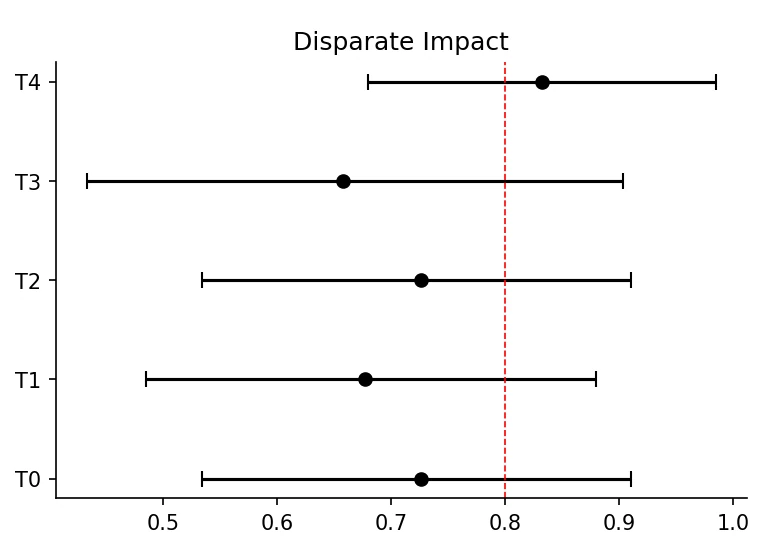
On German Credit the baseline disparate impact was 0.7263 and every confidence interval spanned the 0.8 four-fifths line; the 200-row test block, with 62 women, was underpowered. On the Taiwan set the baseline was already 0.9767; reweighing and ExponentiatedGradient moved it by under 0.004, and group-specific thresholds made it worse. The README says it in four words.
What failed and what changed
No intervention improved fairness
- Result
- A 1.6B tabular foundation model did not distinguishably beat a tuned GBDT either.
- Lesson
- Many published fairness improvements rest on samples too small to support them. Reporting the null result is the finding.
Stack
- Fairlearn
- XGBoost
- scikit-learn
- FastAPI
- Streamlit
235 testsCI run · Oct 2026